


Owner liability is an important issue for vehicle fleets – regardless of the number of vehicles or the sector. The keeper is liable from the very first vehicle . This means that the owner is not only responsible for the proper maintenance and servicing of the vehicle, but also for regular driver’s license checks and driver training in accordance with the accident prevention regulations (UVV).
We know from our daily work with fleet managers: Owner liability rarely fails due to a lack of knowledge – but mostly due to a lack of structures in everyday life. Deadlines are postponed, inspections are carried out irregularly or evidence is not properly documented. This is precisely where risks arise.
But what does keeper liability actually mean – and what should fleet managers really pay attention to? We provide you with an overview of the most important obligations of keeper liability.
Contents
What does owner liability mean in the vehicle fleet?
Owner liability in the vehicle fleet means that the owner of a vehicle is liable for any damage – even if the owner is not responsible for the damage.
This so-called strict liability is regulated in the Road Traffic Act (§7 StVG). The legislator wants to ensure that road accident victims or third parties who have been injured are adequately compensated.
“If a person is killed, the body or health of a person is injured or property is damaged during the operation of a motor vehicle, the owner is obliged to compensate the injured person for the resulting damage.” (§7 StVG)
A practical example: After an accident, it turns out that the last driver’s license check was not documented. Although the driver caused the damage, the company also becomes liable – simply because the proof is missing.
What are the obligations of owner liability?
For companies with their own vehicle fleet, owner liability entails a number of clearly defined responsibilities that the vehicle owner must fulfill. These are based on the Occupational Health and Safety Act (ASchG), the Accident Prevention Regulations (UVV) and the Road Traffic Act (StVG), among others.
However, Fleethouse’s experience shows that many fleet managers are not always aware of how extensive these obligations are and what consequences breaches can have.
In order to avoid risks and be on the safe side legally, you should therefore be familiar with the central tasks of keeper liability and implement them consistently.
UVV driver training
All drivers must be trained in the safe handling of vehicles and how to behave in the event of accidents as part of UVV driver training. The aim is to minimize accidents and health hazards in road traffic and to increase the safety of employees and other road users. The instruction should:
- be carried out before each first journey
- subsequently at least once a year
- be carried out more closely in the event of frequent fines or anomalies
Digital driver instruction
All drivers receive flexible training in the safe handling of vehicles via an e-learning course. All results are verifiably stored.
Driver's License Check
Checking driving licenses is also one of the central obligations of keeper liability. The law does not specify how often drivers’ licenses should be checked. In practice, it is recommended:
- A driving license test every six months
- Driving licenses should be checked more frequently in the event of traffic violations or other incidents
This involves checking whether each employee is in possession of a valid driving license and whether this is sufficient for the respective vehicle class and use in the company. The original driver’s license must be presented during the check – a copy is not sufficient.
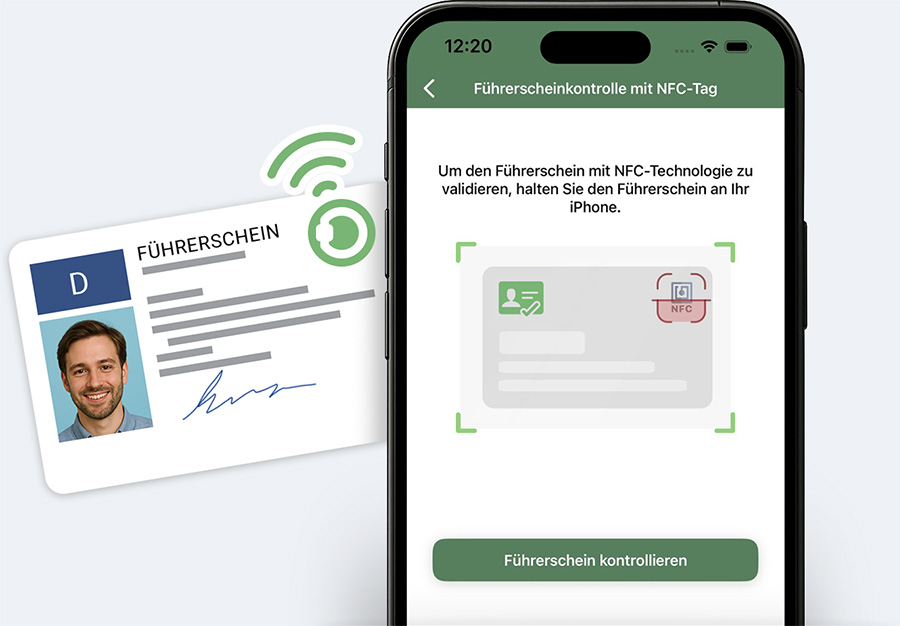
Driver's license check via smartphone app
Less effort, more safety in the fleet with the electronic driver’s license check liva from Fleethouse
Vehicle inspection according to UVV
The UVV test is also part of the owner’s liability. It ensures that the company vehicle meets the legal requirements and can be used safely on the road. The test:
- is carried out by a competent person
- must be completed at least once a year
You should not confuse the UVV inspection with the legally required main inspection open_in_new – also known as the TÜV. Passenger cars and light commercial vehicles must undergo a general inspection every two years, whereas heavy commercial vehicles are required to undergo an inspection every year or every two years, depending on the vehicle type.
Visual inspection
During the visual inspection, the driver ensures that the vehicle is in a roadworthy condition before every journey. Defects and damage must be rectified immediately. Regular training and instruction courses provide drivers with all the knowledge they need to carry out a correct visual inspection. The fleet manager is responsible for rectifying technical faults on the vehicle.
Insurance obligation, tax obligation, notification obligation
The insurance obligation is regulated by law in § 1 of the Compulsory Insurance Act (PflVG) and is also part of the owner’s liability. In this context, one of the most important insurances in the vehicle fleet is liability insurance, through which third parties can be adequately compensated in the event of an accident or damage.
The notification obligation involves the immediate reporting of changes in the vehicle fleet to the responsible authorities, such as the vehicle insurance companies or registration offices – for example in the event of an accident, change of address or change of vehicle owner.
Correct compliance with tax obligations is also important in order to avoid possible fines or penalties. In addition to vehicle tax, this also includes VAT when purchasing or leasing vehicles and, where applicable, trade tax.

Who is responsible for compliance with the owner's liability?
The vehicle owner is responsible for compliance with owner liability in the vehicle fleet. As a rule, this is the management of the respective company to which the vehicles are registered – such as the managing director of a GmbH or the board of directors of a stock corporation.
However, the vehicle owner can also transfer their obligations to a suitable person. This is usually the person responsible for the fleet. It is important to note that although the responsibility can be delegated organizationally, the overall legal responsibility remains with the owner, i.e. the company.
Important terms in this context are:
- Vehicle owner: person or company to whom the vehicle is registered and who bears overall responsibility
- Driver: person who drives the vehicle and is responsible for their behavior on the road
- Vehicle owner: legal owner of the vehicle (e.g. buyer or lessor)
- Duties of the owner: Obligations of the keeper, e.g. driving license checks, driver instruction or maintenance
- Keeper responsibility: legal liability of the keeper in the event of infringements or damage
- Corporate responsibility: Company management must ensure that all legal requirements are met – tasks can be delegated, but the company retains overall responsibility
- Driver liability: Liability of the driver for own misconduct in road traffic
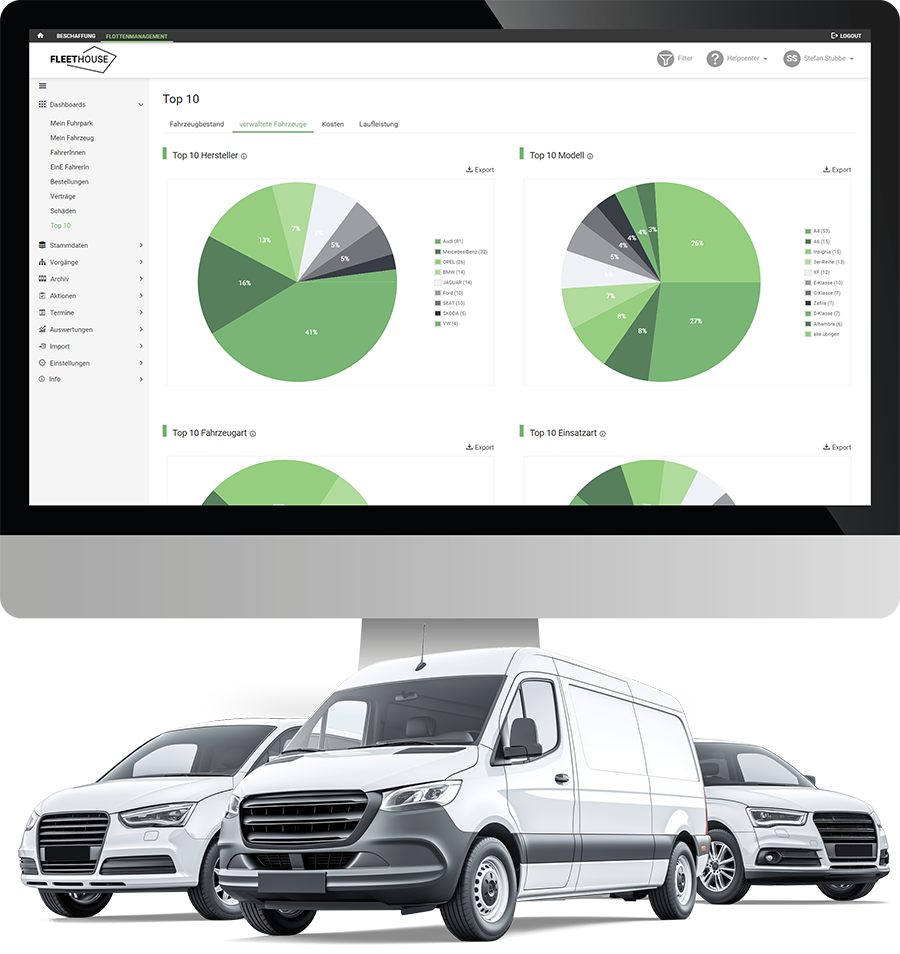
Comply with your keeper obligations
Driving license check via smartphone app and driver instruction via e-learning: this is how keeper liability works with Fleethouse
How is owner liability delegated in the vehicle fleet?
As mentioned above, the company can delegate keeper liability to a responsible person – usually the fleet manager. In order for the delegation to be legally effective, a number of conditions must be met in accordance with Section 9 OWiG open_in_new:
- Written contract: The transfer should always be in writing and clearly regulate which tasks are taken over – such as driver’s license checks, maintenance management or documentation.
- Professional suitability: The appointed person must be professionally suitable and reliable. They must also have the necessary powers and resources to perform the tasks.
- Control: A one-off delegation is not enough – the company must regularly check the delegated tasks and monitor their correct execution.
What happens if the owner's liability is not complied with?
If the owner’s liability and the associated obligations in the vehicle fleet are not complied with, this can have serious consequences in the event of a claim.
Depending on the violation, there is a risk of fines, points in Flensburg or even criminal prosecution – especially if accidents or damage occur as a result of breaches of duty.
Civil liability claims can also result, for example if third parties are harmed and the company has neglected its duty of care. Insurance cover can also be restricted or canceled, which can have considerable financial consequences in the event of damage.
- Missed UVV driver training: fines of up to 10,000 euros
- Failure to carry out a driver’s license check: imprisonment of up to one year or a fine
- Transfer of responsibility to an unsuitable person (supervisory and organizational fault): Imprisonment or a fine of up to 1 million euros
In our daily practice, we see that the greatest risks are often not caused by gross negligence, but by a lack of structures in everyday life. If, for example, driving license checks are forgotten or not properly documented, this can be enough to be held liable in an emergency.
Companies that rely on digital processes and traceable documentation, on the other hand, are significantly better protected and can prove in case of doubt that they have properly fulfilled their keeper obligations.
Free guide
In our guide, you can find out more about keeper liability in the vehicle fleet – from the legal basis to the most important obligations.
Support for owner liability in the vehicle fleet through a software solution
It quickly becomes clear: owner liability in the vehicle fleet is a complex issue. Software can be the solution to keeping an eye on everything and fulfilling your obligations safely. With tools such as driver instruction via e-learning or electronic driver’s licence checks, it helps you to save time and minimize effort.
Driver's license verification
With Fleethouse’s electronic driver’s license check, employees can conveniently check their driver’s license via smartphone app. This means that the check can be carried out anywhere – saving a lot of time and relieving drivers and fleet managers of the time-consuming task of organizing appointments. Fleethouse reminds you of upcoming and overdue deadlines and stores all checks in a traceable manner.
UVV driver training via e-learning
Driver training as an e-learning course takes the strain off your day-to-day fleet operations, as the course content is already fully prepared and can be accessed immediately. Regardless of whether the drivers are in the office, at home or on the road, the training can be carried out flexibly. Fleethouse also reminds you of upcoming and overdue training courses and documents all the results in full.
Appointment reminders for vehicle appointments
Fleethouse helps you not to miss any important deadlines. With the software, you can keep an eye on important deadlines and prevent them from getting lost in the daily work routine.
In our free guide, we give you tips on how a software solution can make your day-to-day fleet work easier: Getting started with digital fleet management
What are the differences in owner liability for different types of vehicles in the fleet?
In principle, owner liability applies to all vehicles in the fleet, but differs in its scope and specific obligations depending on the vehicle type. The reason: as the size, use and hazard potential increase, so do the legal requirements.
Trucks (HGVs)
In addition to the Road Traffic Act, trucks are subject to specific regulations, particularly with regard to load securing and driving and rest times. The liability risks are also higher, as trucks can potentially cause greater damage due to their greater mass.
In addition to the obligatory motor vehicle liability insurance, special insurance policies such as transport insurance for the cargo or environmental liability insurance for the transportation of hazardous goods are often required.
Electric vehicles
Electric vehicles are also subject to specific regulations for safe operation and charging. There are particular risks associated with high-voltage batteries, for example, such as fire hazards and special requirements for the charging station. Motor vehicle liability insurance is mandatory, and additional insurance for the battery and charging station is often advisable.
Arrange an online consultation appointment
Arrange your personal consultation appointment now. You can easily select a suitable appointment using our booking tool.

Anne Fuchs

Ciara Lazeta
The most important facts about keeper liability in the vehicle fleet
Correct and consistent compliance with owner liability is necessary from the very first vehicle in the fleet.
The transfer of owner responsibility should always be recorded within the legally correct framework and, in the best case, in the form of a written contract.
Non-compliance or irregular performance of the obligations may result in severe consequences under criminal law.
FAQ - Owner liability in the vehicle fleet
How keeper liability is handled differs from country to country. While owner liability is regulated similarly in Germany, Austria and Switzerland, there is no general owner liability in the UK. Instead, the driver of the vehicle is usually liable for damage caused by the vehicle.
Owner liability regulates the responsibility of the vehicle owner for damage caused by their vehicle, regardless of who was driving the vehicle. In contrast, driver liability refers to the responsibility of the driver of a vehicle for damage caused by their driving style or behavior.
There are various insurance policies that are specifically designed to cover owner liability and protect the owner of a vehicle from the financial consequences of an accident or claim. First and foremost, this includes motor vehicle liability insurance. This is required by law and forms the basic insurance for every vehicle, covering personal injury, property damage and financial loss caused by the operation of the vehicle.
Partial and comprehensive insurance are voluntary supplementary insurance policies. Passenger accident insurance offers additional protection for the vehicle’s occupants, including the driver.
The owner’s liability has a direct influence on the no-claims bonus class of the car insurance. If a claim is reported and the insurance company pays for it, the owner’s SF class is downgraded. This usually leads to higher premiums. The downgrading varies depending on the insurer and the amount of damage.
Further Fleet Knowledge
If you liked this article and would like to know more about this topic, we recommend this article.
Driving license check via app: digital, safe and efficient
Accident with company car: Who pays?
Further blog posts
Duties in the Fleet: UVV Instruction for Drivers
Electronic driver instruction in accordance with UVV: 5 advantages of an e-learning course
UVV significance in the vehicle fleet: An overview of the accident prevention regulations
Employer driving license check: What you need to consider in the fleet
Driving license check via app: digital, safe and efficient
Accident with company car: Who pays?
Driver’s license check for employers: sample & digital solution
Claims management: The 1×1 for fleet managers
Fleet insurance for your vehicle fleet: this is what matters
Workshop Checklist: How to find the Best Workshop for your Fleet
Loss ratio: definition and calculation
UVV inspection of company cars in the fleet: what you need to consider
Fleet management software: Why Fleethouse is worthwhile for small fleets
Fleet manager training: Qualified for modern fleet management
Fleet app – how to manage your fleet digitally and efficiently
Fleet management: how to manage your fleet efficiently
Fleet management: How to manage your vehicles efficiently
Vehicle management: importance in the fleet and helpful tips
The company car: advantages, challenges and future prospects
Fleet management without Excel: How to save time and money
Digital fleet management: Why even small fleets should digitize their fleets