




CO₂ emissions, energy consumption, and resource use are also playing an increasingly important role in fleet management. Companies are therefore faced with the question of how to organize corporate mobility in a cost-effective manner while also taking climate and environmental goals into account.
In this article, we explain what sustainable fleet management entails and what specific measures companies can take to analyze fuel consumption and CO₂ emissions, use vehicles more efficiently, and further develop their fleets.
Contents
What is sustainable fleet management?
Sustainable fleet management refers to an approach that takes into account not only economic and operational requirements but also CO₂ emissions, energy consumption, and resource use. This may include, for example, the integration of electric vehicles and other alternative powertrains, higher vehicle utilization rates, and alternative mobility concepts such as carsharing or mobility budgets.
Possible goals include, among others:
- Reducing CO₂ emissions and fuel consumption: Depending on the usage profile, electric vehicles, alternative powertrains, and optimized vehicle usage can help achieve this.
- Tapping into cost-saving opportunities: Higher vehicle utilization, route optimization, and fuel consumption analyses can help identify opportunities for cost savings.
- Deploying vehicles based on demand: Usage data provides a foundation for better aligning the vehicle fleet and its deployment with actual demand.
- Making Climate and Environmental Goals Measurable: Fuel consumption, energy, and emissions data can be used to track trends in the vehicle fleet.
Lower emissions thanks to the electrification of the vehicle fleet
Electrifying the vehicle fleet can help reduce the use of fossil fuels in vehicle operations. Electric vehicles do not produce any direct CO₂ emissions from the exhaust while driving. Their overall carbon footprint depends, among other factors, on vehicle manufacturing, the electricity mix, and usage patterns.
Electric vehicles can also offer economic advantages, depending on their usage profile. When evaluating them, factors such as purchase price, energy costs, maintenance, charging infrastructure, and tax policies should be taken into account.
Use of hybrid vehicles
E-bikes as a mobility alternative
A new trend in the mobility industry is the use of company bikes instead of traditional company cars. E-bikes are particularly well-suited for deliveries by company bike or for covering longer distances.
Especially in city traffic, they offer the necessary flexibility while also delivering strong performance. This means that e-bikes can serve as a complement to traditional company cars—particularly for shorter trips—and expand a company’s mobility options.
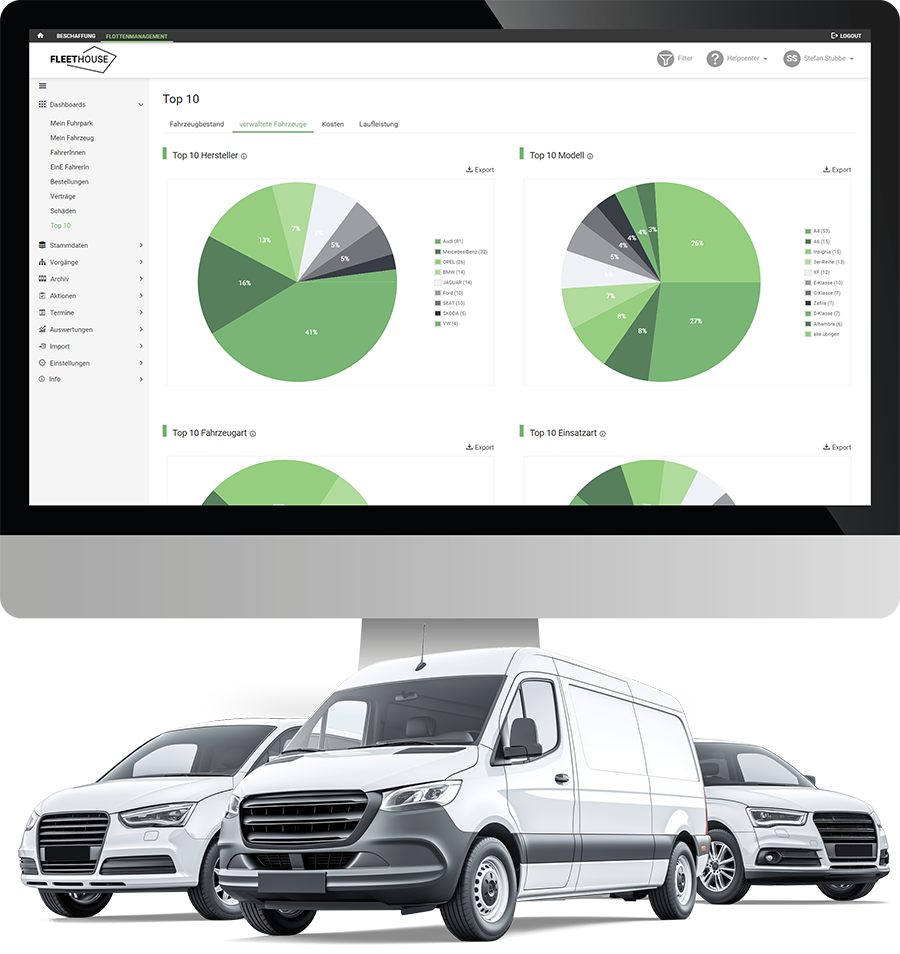
Do you keep an eye on your fleet?
Digitize your fleet in a time and cost effective way with Fleethouse. This leaves you more time for everything else.
Sustainable fleet management through eco-driving
An efficient driving style can help reduce fuel consumption and the associated CO₂ emissions. At the same time, lower fuel consumption can lead to potential savings on fuel costs . In addition to regular maintenance and checking tire pressure, targeted driver training can also help.
One approach to achieving this is “eco-driving.” Through this method, drivers learn how to operate vehicles in the most fuel-efficient manner possible. The basic principles include anticipatory driving, avoiding unnecessary acceleration and braking, maintaining an appropriate speed, and driving within an efficient RPM range.
This type of driving not only reduces fuel consumption but also affects wear and tear and ongoing vehicle costs. For example, accelerating and braking more gently can help preserve brakes, tires, and other vehicle components. Eco-driving is therefore a concrete measure for specifically addressing fuel consumption, CO₂ emissions, and costs within a fleet.
Alternative fuels as the key to sustainable fleet management
In addition to battery-electric vehicles, various alternative powertrains and fuels may be considered, depending on the intended use. However, their impact on CO₂ emissions and energy consumption varies significantly and depends, among other things, on their manufacturing, energy source, and use.
Alternative fuels at a glance:
- Electricity: Battery-electric vehicles are powered by electricity and produce no direct CO₂ emissions from the exhaust while driving. The overall carbon footprint depends, among other factors, on vehicle and battery manufacturing, as well as the electricity used.
- Hybrid technology: Hybrid vehicles combine a combustion engine with an electric motor. The energy generated during braking is used to charge the vehicle.
- Hydrogen: Hydrogen-powered vehicles obtain their energy from fuel cells, whereby hydrogen reacts with oxygen to generate electricity.
- Biofuels: Biofuels, such as biodiesel and bioethanol, are produced from renewable raw materials such as vegetable oils or grain. They can be used in conventional vehicles and blended with conventional fuels.
- Natural gas: Natural gas can be used as compressed natural gas (CNG) or liquefied natural gas (LNG) for vehicles and has lower CO2 emissions compared to conventional fuels.
- E-fuels: E-fuels are synthetic fuels produced using electricity. Their carbon footprint depends, among other factors, on the source of electricity, the production process, and their use.
- Liquefied petroleum gas (LPG): Liquid petroleum gas, also known as LPG, consists of propane and butane and has lower CO2 emissions than petrol or diesel.
Sustainable fleet management through corporate car sharing
Corporate carsharing can help improve the utilization of existing vehicles. When pool vehicles are used by multiple employees, the number of vehicles required may decrease depending on mobility needs. This allows companies to manage both costs and the resource requirements associated with their vehicle fleet.
Electric vehicles can also be integrated into car-sharing programs. Depending on the electricity mix, usage, and the trips they replace, the combination of electric mobility and corporate car-sharing can help reduce traffic-related CO₂ emissions.
Telematics and data analysis for sustainable fleet management
Telematics and data analysis provide a crucial data foundation for the targeted evaluation of vehicles and their use within a fleet. Telematics systems can collect and transmit various types of vehicle data, including, for example, location, speed, fuel consumption, and mileage.
Connectivity in digital fleet management helps fleet managers transparently evaluate vehicle usage and fuel consumption and identify opportunities for optimization. Based on this, they can, for example, review routes, analyze downtime, or deploy vehicles more effectively to meet demand. Depending on the fleet and its usage, measures can be derived from this analysis that help reduce fuel consumption and CO₂ emissions.
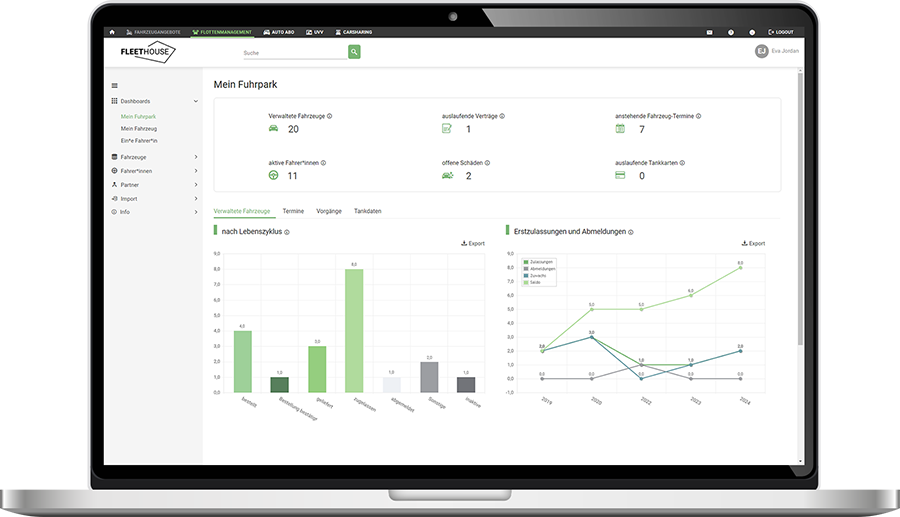
For only €2.90 per month per vehicle
Fleethouse provides you with clear dashboards and an all-round view of your fleet.
Define measurable climate and environmental goals for the vehicle fleet
An important step toward sustainable fleet management is setting specific and measurable goals. Instead of simply aiming for a more sustainable fleet in general, companies can, for example, define how CO₂ emissions or fuel consumption should change over a specific period of time, or what percentage of the fleet should be made up of electric vehicles in the future.
To track progress, relevant metrics should be regularly recorded and analyzed. These may include, for example, CO₂ emissions, energy and fuel consumption, mileage, or the composition of the fleet. Based on this data, companies can monitor progress, identify deviations, and adjust their measures as needed. This creates a robust data foundation for pursuing long-term climate and environmental goals for the fleet.
FAQ - Frequently asked questions about sustainable fleet management
Sustainable fleet management takes into account not only economic and operational requirements but also CO₂ emissions, energy and fuel consumption, and resource use. The goal is to deploy vehicles according to need, ensure transparency in consumption, and identify appropriate measures for the further development of the fleet.
The measures that make sense depend on the specific fleet and its operational profile. Possible approaches include the integration of electric vehicles and other alternative powertrains, an efficient driving style, optimized routes, and higher utilization of existing vehicles. Fuel consumption and emissions data help identify suitable opportunities for cost savings.
Electric vehicles enable locally CO₂-emission-free driving and can reduce the use of fossil fuels during operation. How their overall CO₂ footprint develops depends, among other things, on vehicle manufacturing, the electricity mix, and usage. It is therefore crucial for companies to assess which driving profiles and use cases are suitable for electric vehicles.
Fleet management software can centrally consolidate relevant vehicle, fuel consumption, and emissions data and make it analyzable. This provides fleet managers with a data foundation for tracking trends, detecting anomalies, and identifying opportunities for optimization. The software itself does not reduce emissions, but it can help in determining appropriate measures.
Depending on the objectives, factors such as CO₂ emissions, fuel and energy consumption, mileage, vehicle utilization, and the proportion of different propulsion types can be considered. It is important to set specific and measurable goals and to regularly evaluate the corresponding key performance indicators.
Corporate carsharing can help improve the utilization of existing vehicles and optimize vehicle demand. If this results in a reduced need for vehicles, the fleet’s resource requirements may also decrease. However, the actual effects depend on the specific mobility needs and how the vehicles are used.
Arrange an online consultation appointment
Arrange your personal consultation appointment now. You can easily select a suitable appointment using our booking tool.

Anne Fuchs

Ciara Lazeta
The most important facts about sustainable fleet management
Sustainable fleet management is a comprehensive strategy aimed at minimizing the environmental impact of the vehicle fleet, reducing operating costs and increasing operational efficiency.
Electrification of the fleet, eco-driving, car sharing and alternative fuels are important measures on the way to a sustainable fleet.
The switch to electromobility in the fleet is one of the most important drivers for sustainable fleet management.
Further Fleet Knowledge
If you liked this article and would like to know more about this topic, we recommend these articles.

Vehicle management: importance in the fleet and helpful tips

E-car as a company car: taxes, charging costs and insurance

Charging electric cars at work: advantages and implementation
Further blog articles on the topic of vehicle fleets and sustainability
Fleet Manager: Tasks, Qualifications and Salary
Fleet management: basics and helpful tips
Fleet at a Glance: Importance, Trends and Technologies
Fleet management without Excel: How to save time and money
Fleet management: How to manage your vehicles efficiently
Pool vehicle agreements: Efficiency for corporate car sharing
Alternative drives: sustainable mobility in the vehicle fleet
Company car leasing: advantages, disadvantages and helpful tips!
Fleet app – how to manage your fleet digitally and efficiently